
Custom E. coli Expression Plasmids: Efficient Support for High-Purity Recombinant Protein Production
In life science research and biopharmaceutical development, prokaryotic expression systems remain a widely used platform for recombinant protein production. Compared with many eukaryotic expression systems, E. coli expression plasmids offer advantages such as short growth cycles, low production costs, and relatively simple operation. They are particularly well suited for the production of antibody fragments, enzymes, cytokines, and other recombinant proteins.
However, researchers often encounter challenges during practical applications, including difficulties in selecting the right expression vector, inappropriate tag design, low protein expression levels, and protein solubility issues. In response to these challenges, professional plasmid design and preparation services can help streamline the experimental workflow and accelerate research progress.
Key Technical Elements of Prokaryotic Expression Vectors
A successful E. coli expression plasmid typically integrates multiple functional modules. The promoter system plays a major role in controlling transcriptional activity. The classic T7 promoter can drive high-level expression under IPTG induction, while constitutive promoters such as pJ23119 can be used for continuous, relatively low-level expression when appropriate for the target protein and host system.
The choice of fusion tag can directly affect downstream protein purification and solubility. His tags are widely used for nickel-based affinity chromatography, GST tags can facilitate affinity purification and may improve the solubility of some recombinant proteins, while SUMO tags can help enhance the folding and soluble expression of certain difficult-to-express proteins.
Vector backbone design is equally important. High-copy-number plasmids such as pET-28a can provide high plasmid yields, but higher copy numbers may also increase metabolic burden on host cells. Medium- or low-copy-number vectors can offer a better balance between expression level and host-cell stability for certain applications.
A flexible multiple cloning site (MCS) accommodates the insertion of different target sequences, while appropriate selectable markers, such as kanamycin or ampicillin resistance, enable efficient selection of transformed host cells.
How Professional Services Help Overcome Technical Challenges
Constructing an expression plasmid in-house can often take one to two weeks, particularly when multiple cloning strategies and optimization steps are required. Professional service providers can shorten the overall turnaround time by combining standardized workflows with established plasmid design and production capabilities.
Wuhan MiaoLing Bio Technology Co., Ltd. provides integrated prokaryotic expression plasmid services covering vector selection, sequence optimization, plasmid construction, and sequence verification.

Company reception
The MiaoLingPlasmid platform offers widely used expression systems such as pET-28a, which incorporates a His tag and is compatible with T7 promoter-driven expression, and pGEX-4T-1, which incorporates a GST tag for affinity purification. The platform also supports flexible combinations of inducible and constitutive expression systems.
Based on the characteristics of different host strains, including BL21, Rosetta, and Origami, the appropriate vector and expression strategy can be selected or customized to address common challenges such as inclusion body formation, poor protein solubility, and disulfide bond formation.
Another key advantage is rigorous quality control. Plasmid constructs can undergo sequence verification to confirm the integrity of the designed construct and minimize the risk of mutations or frameshifts. Automated plasmid preparation can also help achieve consistent quality, with applicable products meeting defined endotoxin and structural integrity specifications.
These standardized processes help reduce common issues associated with manual plasmid preparation, such as insufficient purity or elevated endotoxin levels, thereby supporting more consistent downstream protein expression experiments.
From Plasmid to Protein: The Value of an Integrated Solution
Plasmid construction is only the starting point for recombinant protein production. A more complete service workflow can also include large-scale plasmid preparation and technical consultation for expression optimization.
MiaoLingBio provides plasmid preparation services ranging from milligram- to gram-scale production, supporting applications in academic research, pharmaceutical R&D, and gene therapy-related research. Milligram-scale orders can typically be completed within 5–7 business days, while gram-scale preparations can be completed within 1–2 weeks, depending on project requirements. Applicable products can be supplied with restriction digestion verification reports and sequencing documentation.
In practical research applications, customized expression vectors can help researchers optimize recombinant protein production. For example, a research team may use a customized pET-28a-His vector together with codon optimization to improve the expression of a difficult-to-express membrane protein. Another research group may use a pGEX-4T-1 system to rapidly produce a GST fusion protein for downstream antibody development.

Plasmid preparation laboratory
The value of an integrated service model lies in lowering technical barriers and shortening development timelines. Researchers can reduce the time spent troubleshooting molecular cloning strategies and avoid unnecessary repeat experiments caused by inappropriate vector selection.
A standardized delivery package—including plasmid DNA, sequence verification documentation, and relevant culture or induction recommendations—allows researchers to move more efficiently from plasmid construction to protein expression.
Infrastructure and Expertise Behind the Service
High-quality expression plasmid services rely on robust infrastructure, standardized workflows, and experienced technical personnel.
MiaoLingBio operates approximately 4,000 m² of laboratory facilities, including molecular biology laboratories, quality control areas, cold-storage facilities, and dedicated P2-level clean laboratory space. The facilities are equipped with specialized instruments and standardized production infrastructure to support plasmid preparation and related molecular biology services.
The company has a team of more than 130 professionals, with master’s and doctoral degree holders accounting for more than 50% of the workforce. Members of the technical and production teams bring extensive experience in molecular biology and plasmid production.
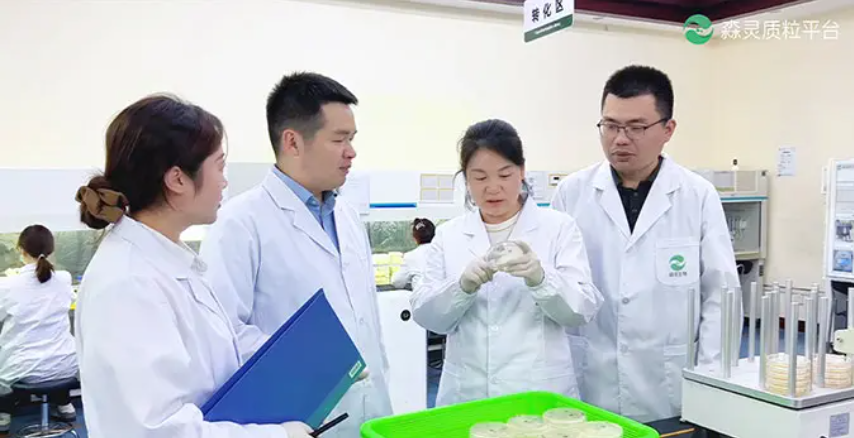
Technical team
MiaoLingBio has provided products and services to more than 6,000 organizations nationwide, covering universities, research institutions, and biotechnology and pharmaceutical companies.
In 2024, nearly 120,000 plasmid products were delivered across more than 60,000 orders. In 2025, the company recorded revenue of RMB 34 million, with annual growth maintained at approximately 30–40%. This growing operational capacity supports stable service delivery and rapid response. Standard turnaround times have been shortened from approximately seven business days to five business days, while average order fulfillment time has been reduced to within eight hours.
In terms of certifications and intellectual property, the company has been recognized as a High-Tech Enterprise and received the 2025 Five-Star High-Tech Enterprise designation in Wuhan. It holds two invention patents and more than 20 utility model patents and has also been recognized as a university student training base in Wuhan.
These qualifications reflect not only the company's technical capabilities but also its ongoing investment in standardized quality management and research infrastructure.
How to Choose the Right Expression Plasmid Service
When evaluating an expression plasmid service provider, several factors should be considered. The breadth of the vector portfolio determines how quickly an appropriate system can be identified, while quality specifications—including endotoxin levels and sequence verification—can directly affect downstream experimental performance. Turnaround time and technical support are also important considerations for maintaining project timelines.
For pharmaceutical R&D projects requiring larger quantities of recombinant protein, it is important to evaluate providers based on their large-scale plasmid preparation capabilities, quality systems, and experience supporting regulated research environments. Academic laboratories may place greater emphasis on cost-effectiveness, flexibility, and customization options.
MiaoLingBio's service model is designed to accommodate both types of research needs. Standardized, ready-to-use vectors such as pET and pGEX series plasmids enable rapid project initiation, while more complex tag combinations, including SUMO-His and MBP-TEV, can be customized for specific protein expression and purification strategies.

Cell experiments
Comprehensive technical support is another important consideration. Professional service providers may offer experimental design consultation, primer design assistance, and recommendations for optimizing protein expression conditions.
For example, when inclusion bodies are encountered, researchers may consider lower-temperature induction, alternative induction conditions, or a different host strain such as Rosetta. When protein degradation is an issue, protease inhibitor strategies and downstream purification conditions may also need to be optimized.
Applications and Future Prospects of Prokaryotic Expression Technology
As synthetic biology and industrial biotechnology continue to advance, the applications of E. coli expression systems are expanding.
In antibody drug development, efficient expression plasmids are increasingly important for producing molecules such as single-domain antibodies and nanobodies. In enzyme engineering, directed evolution and high-throughput screening require the rapid generation and testing of large numbers of expression constructs. In vaccine development, recombinant antigen production also relies heavily on mature and scalable expression platforms.
MiaoLingBio's plasmid products have been used by research teams in a variety of advanced research applications. For example, customized CRISPR-Cas9 protein expression constructs can support genome-editing studies and downstream in vitro assays. Large-scale plasmid preparations can also support industrial enzyme development and other applications requiring substantial quantities of plasmid DNA.
Looking ahead, prokaryotic expression plasmid services are likely to become increasingly modular, automated, and data-driven. Emerging technologies may integrate AI-assisted codon optimization, automated cloning platforms, and high-throughput protein expression screening to further shorten the timeline from gene design to recombinant protein production.
For researchers, selecting a service provider with strong technical expertise, standardized quality control, and scalable production capabilities can help improve research efficiency, reduce trial-and-error costs, and accelerate the transition from plasmid design to successful protein expression.

