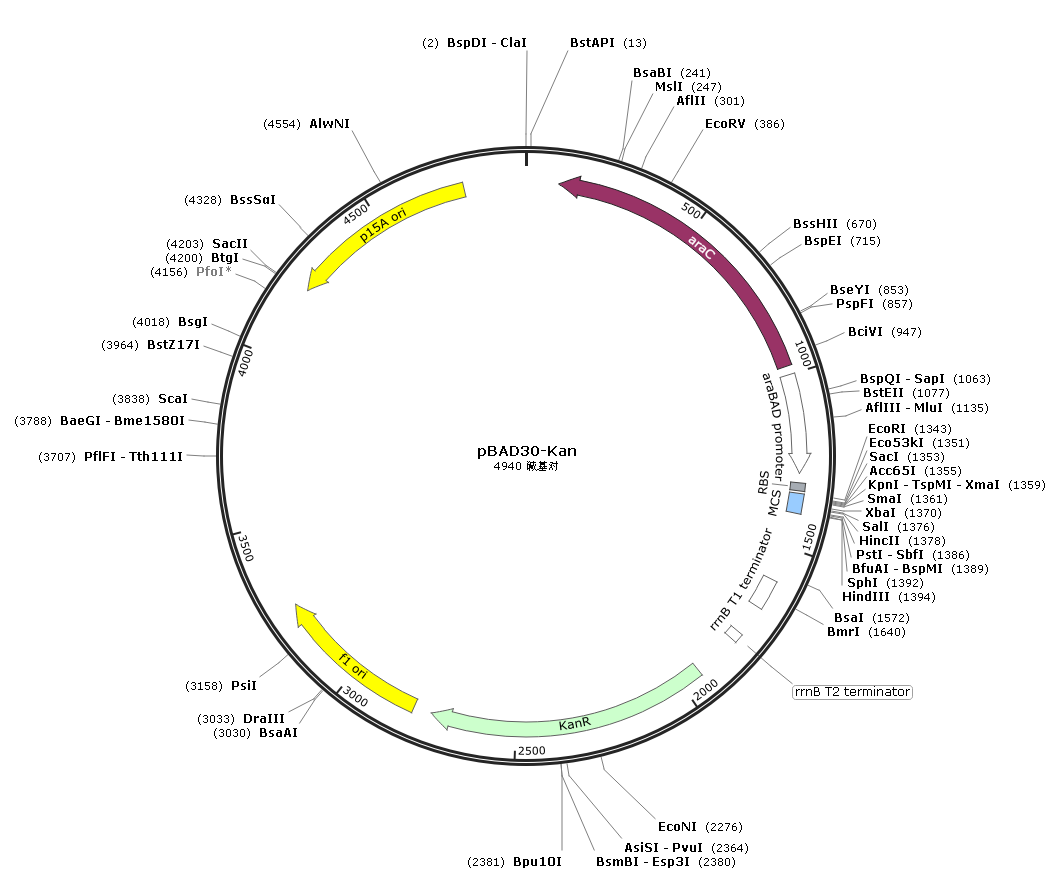
| Plasmid Name | pBAD30-Kan | Plasmid Host | Escherichia coli |
|---|---|---|---|
| Application | Gene expression | Insert Type | ORF |
| Insert Species | Empty vector | Resistance | Kan |
| Promoter | araBAD | Replicon | p15A ori |
| Copy Number | low | Competent Cell | DH5a |
| Culture Temp | 37°C | Forward Primer | G36430-F1: |
| Storage Temp | 37°C |
1.For Research Use Only
All products available through the MiaoLing Plasmid Platform are intended for research use only. They are not intended for clinical trials or for use in humans, including oral administration, injection, or therapeutic use in vivo or ex vivo.
2.Plasmid Sequence and Experimental Performance
Plasmid products are provided and sold based on the corresponding reference/template plasmid. MiaoLing guarantees the accuracy of the specified gene sequence based on our sequencing results, but does not guarantee downstream experimental performance, including gene expression, transfection efficiency, protein expression, or other experimental outcomes.
3.Sequence Verification of Certain Vector Products
For certain vector products, even the original manufacturer may not have fully verified the complete plasmid sequence. If the sequence of the key functional regions has been confirmed to be correct, the product will be considered a correct and usable vector for research purposes.
4.After-Sales Period for Small-Pack Plasmid Products
The after-sales service period for small-pack plasmid products is three months from the date of receipt. Customers are advised to transform and process the plasmid promptly after receipt. After the three-month period, a new purchase may be required for further support or replacement.
5.Research-Related Risks and Limitation of Liability
Scientific research is inherently exploratory and involves a significant degree of uncertainty. To the maximum extent permitted by applicable law, MiaoLing shall not be liable for any additional economic losses, indirect losses, or other liabilities arising from the use of our products or from research outcomes.
6.Citation in Chinese Publications
For publications in Chinese, please cite the product as follows:
7.Product Name (Product Item Number) was provided by the MiaoLing Plasmid Platform.
Citation in English Publications
For publications in English, please cite the product as follows:
“Product Name (Product Item Number) was obtained from MiaoLing Plasmid, China.”
araC             complement(96..974)
                     /codon_start=1
                     /gene="araC"
                     /product="L-arabinose regulatory protein"
                     /translation="MAEAQNDPLLPGYSFNAHLVAGLTPIEANGYLDFFIDRPLGMKGY
                     ILNLTIRGQGVVKNQGREFVCRPGDILLFPPGEIHHYGRHPEAREWYHQWVYFRPRAYW
                     HEWLNWPSIFANTGFFRPDEAHQPHFSDLFGQIINAGQGEGRYSELLAINLLEQLLLRR
                     MEAINESLHPPMDNRVREACQYISDHLADSNFDIASVAQHVCLSPSRLSHLFRQQLGIS
                     VLSWREDQRISQAKLLLSTTRMPIATVGRNVGFDDQLYFSRVFKKCTGASPSEFRAGCE
                     EKVNDVAVKLS"
     araBAD promoter        1001..1285
                     /gene="araBAD"
                     /note="promoter of the L-arabinose operon of E. coli; the
                     araC regulatory gene is transcribed in the opposite
                     direction (Guzman et al., 1995)"
     RBS             1313..1335
                     /note="efficient ribosome binding site from bacteriophage
                     T7 gene 10 (Olins and Rangwala, 1989)"
     MCS    1343..1399
                     /note="pUC18/19 multiple cloning site"
     terminator      1602..1688
                     /gene="Escherichia coli rrnB"
                     /note="transcription terminator T1 from the E. coli rrnB
                     gene"
     terminator      1780..1807
                     /note="transcription terminator T2 from the E. coli rrnB
                     gene"
     KanR             1939..2748
                     /codon_start=1
                     /gene="aph(3')-Ia"
                     /product="aminoglycoside phosphotransferase"
                     /note="confers resistance to kanamycin in bacteria or G418
                     (Geneticin(R)) in eukaryotes"
                     /translation="MSHIQRETSRPRLNSNMDADLYGYKWARDNVGQSGATIYRLYGKP
                     DAPELFLKHGKGSVANDVTDEMVRLNWLTEFMPLPTIKHFIRTPDDAWLLTTAIPGKTA
                     FQVLEEYPDSGENIVDALAVFLRRLHSIPVCNCPFNSDRVFRLAQAQSRMNNGLVDASD
                     FDDERNGWPVEQVWKEMHKLLPFSPDSVVTHGDFSLDNLIFDEGKLIGCIDVGRVGIAD
                     RYQDLAILWNCLGEFSPSLQKRLFQKYGIDNPDMNKLQFHLMLDEFF"
     f1 ori      2800..3255
                     /direction=RIGHT
                     /note="f1 bacteriophage origin of replication; arrow
                     indicates direction of (+) strand synthesis"
     p15A ori      complement(4216..4761)
                     /direction=LEFT
                     /note="Plasmids containing the medium-copy-number p15A
                     origin of replication can be propagated in E. coli cells
                     that contain a second plasmid with the ColE1 origin.
"